Weighbridge vs Truck Scale: What's the Difference and Which Do You Need?
Type "weighbridge" into one search box and "truck scale" into another and you will be shown largely the same equipment. For a procurement team trying to write a defensible specification, that is confusing: are these two products, or two words for one product? The short answer is that in most markets they are the same machine — a large platform fitted with load cells that weighs an entire vehicle while it is stationary. The longer, more useful answer is that the real decision is not about naming at all. It is about which weighing approach fits your site: a fixed static weighbridge, a portable axle-weighing system, or a dynamic weigh-in-motion installation. Each solves a different problem, and choosing the wrong category is far more costly than choosing between two suppliers of the same category. This guide separates the terminology from the engineering so you can brief a manufacturer with confidence. Jiajia Weighing is a weighing equipment manufacturer based in Yantai, Shandong, China, working across all three approaches.
One machine, two names
The vocabulary is regional, not technical. "Weighbridge" is the common term in the UK and across much of Asia, Africa, the Middle East and Latin America; "truck scale" is the everyday term in North America. International suppliers and B2B marketplaces use both, often in the same sentence, which is why buyers in Southeast Asia or the Gulf frequently search for both phrases when they are actually sourcing one piece of equipment.
What the terms describe is a single class of equipment: a deck, a set of load cells, a junction box, an indicator and usually some software to record and report the weight. If a quotation arrives under one label and your tender document uses the other, you are almost certainly looking at the same thing. Do not let a supplier manufacture a distinction where none exists, and do not pay a premium for a "truck scale" when the specification in front of you is a weighbridge. Where the word does carry a hint of meaning, it is loose: some people reserve "weighbridge" for a permanent, foundation-mounted installation and "truck scale" for any large vehicle scale, but that is a habit, not a standard, and it should never drive a purchasing decision on its own.
The split that actually matters: static, portable, dynamic
Once the naming question is out of the way, three genuinely different technologies remain, and each is a legitimate answer to a different brief. Confusing them is the expensive mistake; the label on the quotation is not.
A fixed static weighbridge is installed on a prepared foundation and weighs a vehicle at a complete stop. It is the reference approach for trade settlement, inventory control and site dispatch, where repeatability and a clear, defensible gross weight matter most. Because the vehicle is stationary and fully on the deck, the reading is stable and easy to audit.
A portable truck weighing scale uses pad-based axle weighing that can be moved between sites and needs no civil foundation. It trades the convenience of a permanent deck for flexibility: the same equipment can serve a temporary quarry, a harvest season or several depots in rotation. A weigh-in-motion (WIM) system weighs vehicles as they drive over sensors installed in the lane, without stopping. That is a different job again — screening and enforcement on moving traffic rather than settling a single transaction. The three are not better or worse versions of one another; they are tools for different operational questions.
Fixed static weighbridge — the default for trade and yards
For most ports, mines, logistics parks and factory gates, the static weighbridge is the right starting point. It is built around a fully welded U-steel deck with sealed internal chambers that keep moisture and contamination out of the load-bearing structure. Deck designs pass 2,000,000-cycle third-party fatigue testing, and surface protection is Sa2.5 shot blasting with two coats of primer and two coats of finish at a dry film thickness of at least 120 microns — specifications that matter when a deck lives outdoors under constant heavy traffic in humid or coastal conditions.
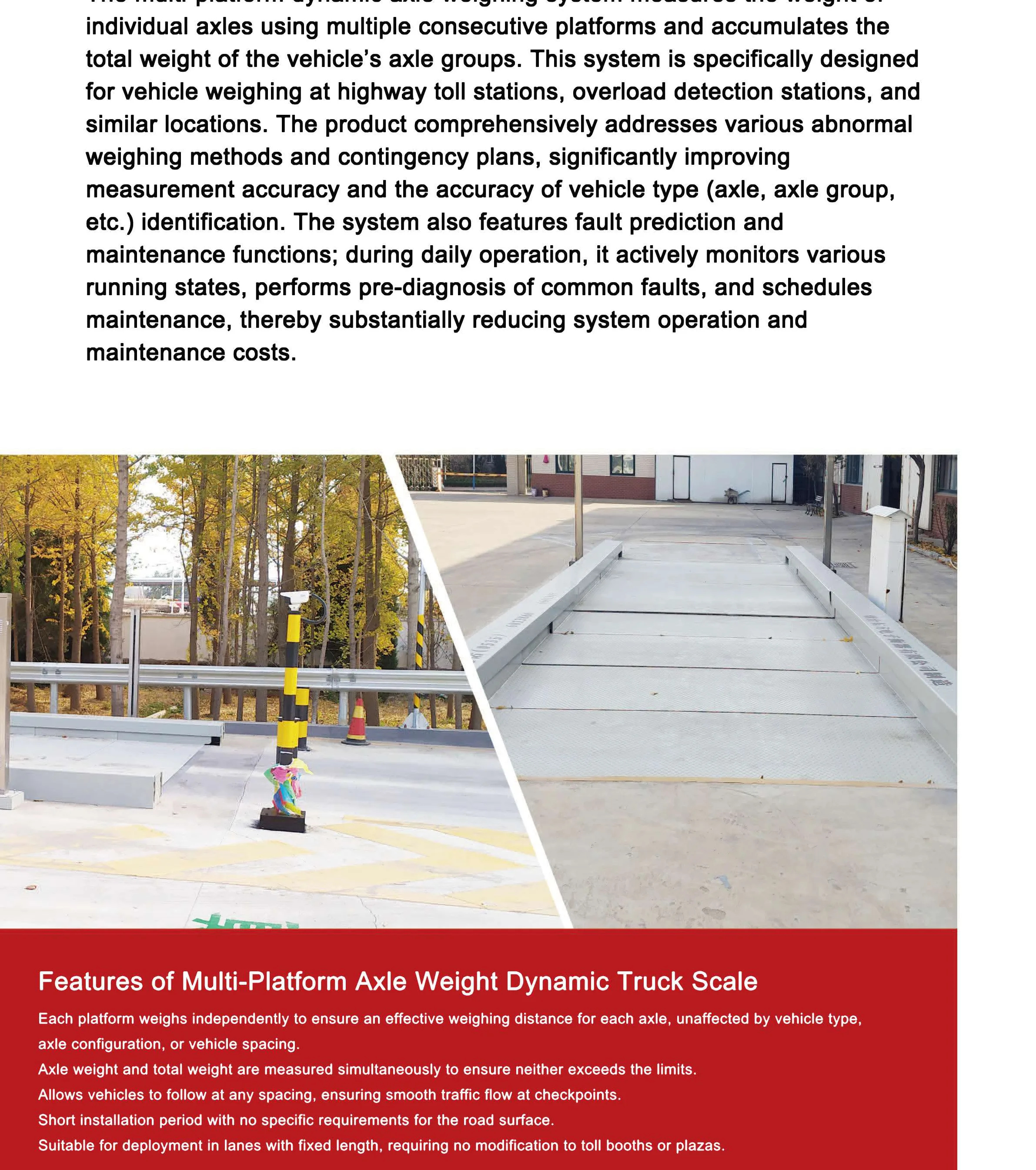
Standard platforms are 3500 × 1000 mm with a widened 4200 × 1000 mm option, and the range covers 20, 50 and 100 ton classes. For fleets with mixed axle configurations, a ZDG-type multi-platform layout weighs each platform independently, capturing axle loads and gross weight in one pass and allowing the deck to be adapted to different wheelbases. Custom deck sizes are available, so the platform can be matched to the actual vehicle list rather than to a generic size.
Details that protect accuracy over a long service life are worth specifying: a cover-free deck shields the load cells, a mid-span lap joint design avoids deck lifting and cuts lateral sensor stress, and robotic welding on all seams gives consistent penetration under repeated loads. See the weighbridge range for how the capacity classes are organised, or the truck weighing scale page for static and dynamic configurations. If the requirement is "weigh every truck accurately, once, at rest", this is the category to specify.
When a portable or dynamic system is the better answer
Static is not always the answer. Where the site is temporary, the ground cannot take a foundation, or one budget must cover several locations, portable truck weighing scales are worth a serious look: they weigh axle by axle, move between sites and avoid civil works entirely. The trade-off is that weighing is a deliberate, stop-and-position operation rather than a drive-through one, so they suit lower-throughput or mobile operations.
Dynamic weighing is the opposite case. Our weigh-in-motion line uses a wide-flange plate sensor just 58 mm thick that can be buried directly in the road without a civil pit, rated IP68 with 150% overload tolerance. Full-wheel load integration removes the errors caused by off-centre or irregular driving, and the system carries a stated dynamic accuracy of ±0.5% (gross weight Class 1, single axle Class E) at traffic speeds from 1 to 100 km/h. That combination — thin sensor, no pit, sealed electronics — is what makes non-stop weighing practical on a live lane.
It is designed for overload enforcement at highway entrances, toll stations and control points, with licence-plate capture, LED information signs and data collection as part of the wider system. The software layer adds image and video linkage, anti-cheating logic for irregular manoeuvres such as S-bend approaches, sudden acceleration and dragging across the sensor, unattended 7×24 operation, local caching when the network drops, and centralised management of multiple sites. That is a screening and enforcement tool, not a replacement for a trade-settlement weighbridge, and the stated accuracy class should be matched to the enforcement requirement.
A decision checklist by scenario
Frame the choice by what the weighing result is used for. For commercial trade, inventory and dispatch where a single accurate gross weight is the deliverable, specify a fixed static weighbridge. For temporary, multi-site or low-throughput operations where mobility matters more than permanence, look at portable axle pads. For non-stop traffic that must be screened for overload without stopping, weigh-in-motion is the appropriate technology. If the plan includes driverless or remote operation, decide that up front, because it changes the power, network and on-site housing needs — our unattended weighing solution is built around those conditions.
Across all three, confirm the accuracy class and how it is verified, and ask whether the manufacturer keeps research, manufacturing, installation and maintenance in-house. A supplier that builds, installs and services its own equipment can answer the whole specification rather than just the deck; see the delivery and service page for what that support covers. We are trusted in 70+ countries and produce 10,000+ units a year, with payment by T/T, MOQ 1 unit and typical delivery around 60 days on EXW, FCA, FOB, CNF, CIF, DAP or DDP terms.
Still unsure which category fits your operation? Send the vehicle types, traffic speeds and site conditions to our engineers through the contact page and we will recommend a configuration, MOQ 1 unit, with no obligation.